
2025-03-19 06:30:00


INDIA NEED COAL

By Pradeep Kaimal Special Correspondent, Indoen
ENERGYCENTRAL - Mar 17, 2025 - As India strides towards becoming a $5 trillion economy, its coal sector is undergoing a transformation. With record production levels, reduced import dependency, and ambitious clean energy goals, the country is redefining its energy narrative. But can coal and sustainability coexist?
The coal conundrum
India’s energy landscape is a study in contrasts. On one hand, the country is a global leader in renewable energy adoption, with ambitious targets for solar and wind power. On the other, coal remains the backbone of its energy mix, accounting for 55% of the national energy supply and over 74% of power generation. This duality underscores a critical challenge: how to meet the energy demands of a rapidly growing economy while transitioning to a sustainable future.
Recent data from the Ministry of Coal highlights the sector’s remarkable growth. In the fiscal year 2023-24, India’s coal production reached an all-time high of 997.82 million tonnes (MT), a significant jump from 609.18 MT in 2014-15. This growth has been accompanied by a reduction in coal imports, saving the country billions of dollars and enhancing energy security. Yet, as global climate commitments tighten, the role of coal in India’s energy strategy is under scrutiny.
This article delves into India’s coal boom, exploring its economic, environmental and social dimensions. This will also examine the policies driving this growth, the challenges of balancing energy security with sustainability and the innovative technologies reshaping the sector.
The economic engine: Coal’s role in India’s growth
India’s coal sector is not just an energy provider; it’s a critical driver of economic growth. The sector contributes significantly to industrial expansion, accounting for 50% of Indian Railways’ freight revenue and providing direct employment to nearly 4.78 lakh individuals. In December 2024, the coal sector registered a growth rate of 5.3%, the highest among the eight core industries, underscoring its pivotal role in the economy.
The government’s focus on increasing domestic coal production has yielded impressive results. Between April and November 2024, coal imports declined by 5.35%, saving approximately $3.91 billion. This reduction in import dependency has been achieved through a combination of policy initiatives, including the ‘Mission Coking Coal’ launched in 2022, which aims to increase domestic coking coal production to 140 MT by 2030.
Private sector participation has also surged, with coal production from private sources increasing from 58 MT in 2018-19 to 184 MT in 2023-24. This growth has been facilitated by the introduction of commercial coal mine auctions in 2020, which have attracted significant investment and modernised the sector.
The sustainability challenge: Can coal go green?
While the economic benefits of coal are undeniable, its environmental impact cannot be ignored. Coal combustion is a major source of greenhouse gas emissions, contributing to climate change and air pollution. In a country where air quality is a pressing concern, the environmental cost of coal is a significant challenge.
However, the Indian government is taking steps to mitigate these impacts. One of the most promising initiatives is coal gasification, a process that converts coal into synthetic gas, which can be used for power generation, fertiliser production, and other industrial applications. The Cabinet’s approval of a ₹8,500 crore ($1.02) scheme to promote coal gasification projects in January 2024 marks a significant step towards cleaner coal utilisation.
The scheme aims to achieve 100 MT of coal gasification by 2030, reducing carbon emissions and enhancing energy security. Projects under this initiative, such as those by Bharat Coal Gasification and Chemicals Limited and the CIL-GAIL Consortium, are expected to play a crucial role in this transition.
In addition to technological innovations, the coal sector is embracing sustainability through large-scale afforestation efforts. In 2024 alone, over 54.06 lakh saplings were planted across 2,372 hectares, with initiatives like the ‘Ek Ped Maa Ke Naam’ (A Tree in Mother’s Name) campaign further boosting these efforts.
The global context: India’s coal strategy in a decarbonising world
India’s coal strategy is unfolding against the backdrop of a global energy transition. Countries around the world are committing to net-zero emissions targets, and international pressure to phase out coal is mounting. However, India’s situation is unique. With a per capita energy consumption significantly lower than the global average, the country faces the dual challenge of meeting its energy needs and reducing emissions.
India has consistently argued for a just and equitable energy transition, emphasising the need for developed nations to take greater responsibility for historical emissions. At the same time, the country is making significant strides in renewable energy, with targets to achieve 500 GW of renewable capacity by 2030.
The question, then, is not whether India should abandon coal, but how it can manage its coal resources responsibly while accelerating the transition to renewables. This balancing act is at the heart of India’s energy strategy.
Earlier:

2025, February, 20, 06:30:00
INDIA RENEWABLES 500 GW
India is forging ahead with its ambitious target of achieving 500 GW of renewable energy capacity by 2030, as reaffirmed by industry leaders at the recently concluded India Energy Week 2025.

2025, February, 13, 06:25:00
INDIA'S LNG IMPORTS WILL DOUBLE
Demand for the super-cooled fuel from the world’s fourth-largest buyer will rise to an annual 64 billion cubic meters by 2030, up from 36 billion last year, according to the IEA’s latest report on the Indian gas market, published on Wednesday.

2025, February, 13, 06:20:00
INDIA'S NUCLEAR SMR
Indian Railways has been seen as a potential joint venture partner for nuclear projects for many years: as long ago as 2017 NPCIL said it planned a joint venture with the state-owned enterprise.

2025, February, 7, 06:35:00
INDIA NEED NUCLEAR
India currently has an installed nuclear capacity of 8,180 MWe, according to the Atomic Energy Regulatory Board.

2025, January, 29, 06:40:00
INDIA RENEWABLES 217 GW
India aims to achieve 500 GW of non-fossil fuel-based energy capacity by 2030, with an intermediate target of 358 GW at the end of 2026.

2024, December, 13, 06:45:00
INDIA NEED RUSSIAN OIL
India's rising Russian imports have come at the expense of rival Middle Eastern producers. The Reliance-Rosneft deal would represent another challenge for competitors, including Saudi Arabia.

2024, November, 14, 06:50:00
INDIA, RUSSIA TRADE: UP 5 TIMES
Trade between the traditional allies have shot up five times in the past three years, according to trade ministry data, as India lapped up Russian crude oil while most others shunned its barrels following the invasion of Ukraine.
2024, November, 14, 06:45:00
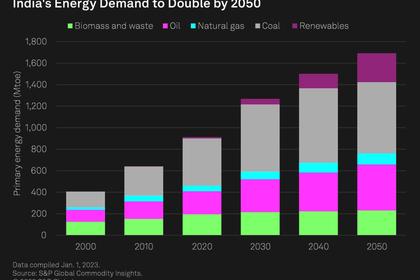
INDIA ENERGY TRANSFORMATION
Since gaining independence in 1947, India's power sector has achieved remarkable growth, with the installed capacity soaring from a mere 1,300 MW to an impressive 400 GW by 2023. This growth trajectory has been propelled by strategic investments in thermal, hydro, and renewable energy, underlining the sector's resilience, adaptability, and alignment with global sustainability goals.