
2026-02-10 13:10:00


CHINA EMISSIONS DOWN
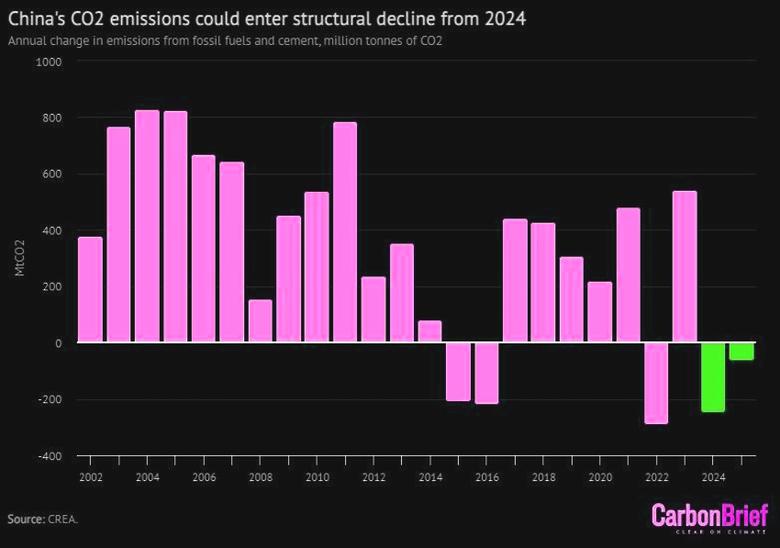
FORBES - Feb 01, 2026 - For the first time, China’s carbon emissions fell even as electricity demand continued to rise—a development that, if sustained, would challenge one of the most persistent assumptions in climate economics: that growth inevitably brings higher emissions.
Since early 2024, China’s emissions have been flat or declining, according to multiple independent trackers, even as power consumption climbed. The shift has been driven primarily by a surge in clean electricity generation and rapid adoption of electric vehicles, raising a consequential question with global implications: has the world’s largest emitter finally reached a structural turning point rather than a temporary dip?
"China and many developing countries are deploying solar and wind, and electric vehicles at a pretty breakneck pace," Glen Peters, a climate scientist, told Science magazine.
China’s clean energy expansion is no longer marginal. In 2024 alone, the country added more wind and solar capacity than the rest of the world combined, pushing renewable generation growth ahead of demand growth for the first time at scale. That divergence matters. It means new electricity demand is increasingly being met by clean sources rather than coal.
This shift did not happen by chance. Indeed, China’s energy system has grown to the point where clean power is now large enough to materially alter the long-standing relationship between economic growth and carbon emissions, as noted by distinguished professor of climate change Dabo Guan at Tsinghua University. In earlier periods, renewable growth was too small to matter system-wide. Today, it is large enough to displace fossil generation even when demand rises.
The transformation extends beyond the power sector. Electric vehicles now account for a majority of new car sales in China, which is flattening growth in oil demand. Unlike efficiency gains, which can be offset by increased use, electrification permanently displaces gasoline and diesel consumption.
That distinction is critical. Slower economic growth can temporarily suppress fuel demand. Technology substitution, by contrast, alters long‑term consumption patterns.
Analysts at the International Energy Agency have noted that China’s transport electrification is now a major factor in moderating global oil demand growth—a trend unlikely to reverse even if economic activity accelerates. The agency reported that China accounted for 60% of global electric car sales in 2023.
A Growing Economy Without Growing Emissions
China’s economy is still growing—unevenly and more slowly than in the past, but growing nonetheless. Electricity demand has risen accordingly. Yet coal generation has not followed the same trajectory.
So, China is now a test case — one that examines whether a large, industrial economy can expand without a parallel rise in emissions. Unlike wealthy economies that reduced emissions only after their industrial growth had matured, China is attempting to do so while still developing—and on a far larger scale.
“We’re studying China’s technological progress, not only in photovoltaics, but also in wind power, solar thermal energy, onshore wind, offshore wind, and nuclear energy,” Jiang Kejun, from the Energy Research Institute of China’s National Development and Reform Commission, told RFI.
The country’s push for clean energy is motivated as much by air quality concerns as by climate commitments. China’s Ministry of Commerce noted that the country hosts more than 1 million multinational corporations, drawn by both lifestyle and economic opportunity.
China’s emissions trajectory also carries strategic consequences. Its dominance in manufacturing solar panels, batteries, and electric vehicles means domestic deployment reinforces global market power. The same policies that lower emissions at home are reshaping supply chains abroad—triggering trade tensions even as they drive down clean-technology costs worldwide.
China is not only reducing emissions at home; it is also developing and exporting technologies that enable decarbonization elsewhere—and securing the manufacturing jobs and profits that flow from them.
Skeptics caution against declaring a turning point too soon. China’s emissions growth slowed or reversed in 2015–2016 amid industrial restructuring, and again in 2020 during the pandemic—only to rebound when stimulus revived construction and heavy industry.
The Coal Question And The Risk of Rebound
Parts of that pattern are visible today. The property sector remains weak, steel and cement output are subdued, and local governments have been cautious about launching large infrastructure programs. Any slowdown in industrial activity reduces emissions regardless of the energy mix. The question is whether clean energy growth is now strong enough to prevent a rebound even when heavy industry recovers.
The Centre for Research on Energy and Clean Air released a report in December 2025 warning that China risks an emissions rebound. While the group acknowledged that emissions had been flat or falling for 18 months, it remained concerned about a surge in coal use.
Undoubtedly, coal remains the unresolved risk. China continues to permit and construct new coal-fired power plants, often framed as insurance against grid instability and extreme weather. While capacity additions do not automatically translate into higher emissions, the presence of that infrastructure raises the possibility of a rebound during periods of stress.
This tension—clean energy rising even as coal capacity expands—remains one of the central contradictions in China’s transition. Much of this new coal capacity reflects local concerns about grid reliability rather than a genuine need for more coal generation. Much of this new coal capacity is intended for emergency or peak‑load use, so China is expanding the number of coal plants even though those plants are not expected to run often or significantly increase coal-fired output.
Nevertheless, even the Centre for Research on Energy and Clean Air is cautiously optimistic: “On balance, China’s clean energy boom has a momentum of its own and has gained high economic significance both nationally and on the provincial level, which makes it more likely that the boom will continue. It’s clear that after the impressive growth of the clean energy sectors, China has the capability to keep emissions falling and start making progress towards its carbon neutrality target.”
What distinguishes the current plateau from earlier episodes is not the absence of coal or economic weakness, but the scale of clean energy substitution already underway. Electricity demand is rising, not falling—yet coal generation has flattened. That divergence did not exist in previous slowdowns.
Whether it holds through the next economic cycle will determine whether China’s emissions trajectory has truly changed.
As the World Economic Forum has written, the decisive test is whether clean energy growth continues to outpace demand when growth accelerates again. If it does, China’s emissions profile could begin to look fundamentally different from anything seen before. “This is the first time clean power generation has been responsible for a drop in China’s carbon dioxide.”
If China has indeed reached a durable emissions peak, the implications extend far beyond its borders. The success of the Paris Agreement depends heavily on how quickly China replaces coal with clean power and modernizes its grid.
Whether this emissions decline marks a turning point or just another pause remains uncertain. But the center of gravity in global climate outcomes has already shifted—from national pledges to how China powers its economy. If the structural changes underway in China take root, they will influence global emissions trajectories more than any other single national decision.
-----
Earlier:

2025, October, 8, 06:30:00
CHINA NEED INDONESIA COAL
China, which accounts for around 40% of Indonesia's thermal coal exports at around 150 million mt/year, is a major price setter in the seaborne market, and domestic prices are often influenced by import prices.

2025, September, 24, 06:35:00
CHINA'S NUCLEAR DEVELOPMENT
The contract, worth CNY4.2bn ($594m), was awarded to a joint group of companies, China Energy Engineering Jiangsu Electric Power Construction No 3 Company and China National Nuclear Huachen Construction Engineering Company. They will build the nuclear islands, their auxiliary systems and part of the equipment for the balance of the station.

2025, July, 30, 06:05:00
CHINA URANIUM PRODUCTION
China National Nuclear Corporation (CNNC) broke ground for the project on 12 July 2024.

2025, May, 22, 06:35:00
CHINA'S ENERGY SYSTEM WILL UP
Since 2019 China’s energy system seems to be undergoing significant shifts.

2025, April, 17, 06:50:00
CHINA BUYING IRANIAN OIL
On April 10, the US Department of the Treasury sanctioned nearly 30 oil tankers involved in shipping Iranian crudes, as well as a Chinese storage terminal.

2025, April, 17, 06:40:00
CHINA COAL ENERGY UP
As of end- 2024, coal-fired power represented 37% of China’s installed capacity but 60% of its power generation.

2025, April, 17, 06:25:00
CHINA'S NUCLEAR FOR PEACE
China operates 58 civil nuclear reactors and has almost 30 new builds in progress. This represents nearly half of all power reactors currently under construction worldwide.

2025, March, 19, 06:40:00
CHINA WITHOUT U.S. LNG
China is also boosting its energy security by focusing on producing more gas at home, which will help to curb import growth.